


| | |
 |
|
| 
| ||
 |
|

|
|
 |
|
Wildlife, Animals, and Plants |
|
|||
|
FIRE EFFECTS
IMMEDIATE FIRE EFFECT ON PLANT:Although bottlebrush squirreltail is generally top-killed by fire, its small size and low density of coarse fuel per unit basal area make it relatively fire tolerant [31,198,208]. Low density of above ground plant tissue produces a quick, "hot" flame, transferring little heat to growing points below the soil surface [208,210]. The solid culms of bottlebrush squirreltail do not readily burn, compared to those of perennial grass associates [210].<
DISCUSSION AND QUALIFICATION OF FIRE EFFECT:No entry
PLANT RESPONSE TO FIRE:Bottlebrush squirreltail sprouts from surviving root crown [29,201] and colonizes from seed [29]. Seasonal trends in bottlebrush squirreltail root carbohydrate reserves greatly affect postfire response. Burning is generally harmful during late spring and early summer [30,208] coinciding with low points in carbohydrate reserves [20]. Bottlebrush squirreltail is most tolerant of late summer (anthesis) or mid-fall (before regrowth) fires [30,49,79], coinciding with relatively high carbohydrate reserves [20]: 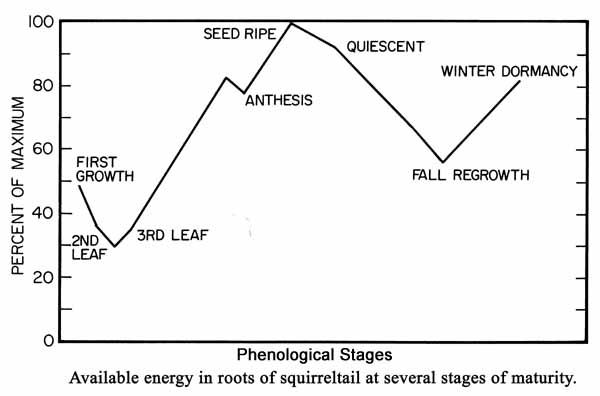 A difference in phenological traits of surviving postfire individuals may exist between small (1 to 3 inch (2.5-7.6 cm) crown diameter) and large (>3.5 inches (8.9 cm) crown diameter) bottlebrush squirreltail plants. Wright [210] found large plants to produce significantly (p<0.01) higher numbers of flowering stalks than small plants after fire.
DISCUSSION AND QUALIFICATION OF PLANT RESPONSE:Wright [208] compared bottlebrush squirreltail response to burning and clipping near Boise, Idaho. Heat was applied by propane burner for 20 to 30 seconds to raise soil surface temperature to 400 or 800 degrees Fahrenheit. The 800 degree Fahrenheit treatment killed 25% of bottlebrush squirreltail plants during July and August. No other treatment caused mortality. Burning and clipping during all seasons reduced yields 1 year after treatment. Burning reduced yield most during May. Average herbage weight (in grams) per bottlebrush squirreltail plants in relation to season and treatment at 1 postfire year is summarized below:
a Differences from clipped treatment significant at p<0.05 b Differences from 400 °F treatment significant at p<0.05 Wright [207] conducted time/temperature evaluations of bottlebrush squirreltail mortality on 5 dates between 19 May and 21 September, at temperatures between 120 to 200 degrees Fahrenheit (48.9-93.3 °C). Time required to kill bottlebrush squirreltail tissue at all temperatures within the test range increased as burning date increased. The greatest change occurred between 10 June and 21 July. Time (minutes) required to kill bottlebrush squirreltail tissue at 172 degrees Fahrenheit (78 °C) [208]:
Fox [77] found a direct association between postfire response of bottlebrush squirreltail and ponderosa pine tree density and canopy cover. The greatest cover (%) of bottlebrush squirreltail was achieved in areas with larger (>4 inches (10 cm) diameter) trees and less dense tree canopies. Blank and others [26] grew bottlebrush squirreltail under greenhouse conditions in soil from a July wildfire site and adjacent unburned areas within a big sagebrush habitat of Nevada. Bottlebrush squirreltail had greater aboveground biomass and more total N, P and K, along with greater silica content, when grown in soil collected from wildfire sites. Spring: Early spring fire (May) within sagebrush ecosystems of eastern Oregon greatly reduced bottlebrush squirreltail basal area [31,32]. Basal area decreased an average of 47 % the 2nd postfire year. Britton and others [31] compared bottlebrush squirreltail postfire response in eastern Oregon to clipping. Yield (1 postfire year) after a May fire was less than yield from clipping (down to 0.4 inch (1 cm) stubble). Results the 2nd year showed no significant difference. Bottlebrush squirreltail populations increased after a "moderate" spring (May 1972) wildfire in a ponderosa pine forest on limestone-sandstone derived soils, near flagstaff Arizona. The area observed was logged 2 years before, averaging 16,875 board feet/acre (6,750 board feet/ha). Number of bottlebrush squirreltail stems per hectare in 1972 and 1974 is summarized below in thousands/ha [17]:
Although frequency of bottlebrush squirreltail was too low for statistical analysis, Champlin [42] reported no damage to bottlebrush squirreltail basal cover and height 2 postfire years after a spring fire in a big sagebrush community of northern California. Bottlebrush squirreltail vigor increased the 1st and 2nd postfire growing season in central Oregon, following a spring fire within a sagebrush-bitterbrush/bunchgrass plant community [1].
Summer:
FIRE MANAGEMENT CONSIDERATIONS:Humphrey and Schupp [103] compared bottlebrush squirreltail seedling emergence within burned and unburned cheatgrass dominated areas of the Great Basin, Utah. Greater seedling emergence (April) occurred on seeded burned areas compared to unseeded, within loamy fine sand (85% sand) sites. On a dune site with sandy soil (95% sand), seedling emergence occurred in March with no significant difference between burned and unburned sites. However, a significantly greater proportion of bottlebrush squirreltail seedlings survived on burned dune areas compared to unburned.
Seeding:
Seeding postfire pinyon-juniper communities of the Great Basin with desert wheatgrass (Agropyron desertorum), intermediate wheatgrass (Thinopyrum intermedium), and smooth brome (Bromus inermis) inhibits establishment of bottlebrush squirreltail [120]. Pinyon-juniper communities: Four years after a late summer (July-August) wildfire in pinyon-juniper woodlands of Mesa Verde, Colorado, Erdman [67] found bottlebrush squirreltail as an important component. Bottlebrush squirreltail, along with Indian rice grass and mutton grass, assumed dominance after a 3-year annual grass/forb stage. At 25 postfire years, bottlebrush squirreltail is a member of climax stands. Within pinyon-juniper ranges of west-central Utah, bottlebrush squirreltail is an important native perennial species at 5 to 6 postfire years [13]. A fire return interval less than 10 to 25 years should increase abundance of bottlebrush squirreltail in newly expanded (young) western juniper stands (Juniperus occidentalis) receiving greater than 14 inches (350 mm) precipitation, at elevations higher than 4,900 feet (1,500 m), in southwestern Idaho [35].
Related categories for SPECIES: Elymus elymoides | Bottlebrush Squirreltail |
 |
 | |


| |
| |
| Content on this web site is provided for informational purposes only. We accept no responsibility for any loss, injury or inconvenience sustained by any person resulting from information published on this site. We encourage you to verify any critical information with the relevant authorities. | |
| |
|
About Us | Contact Us | Terms of Use | Privacy | Links Directory |
| 1Up Info All Rights reserved. Site best viewed in 800 x 600 resolution. |


